


Blog
Stop running your farmers market on a spreadsheet
April 8, 2026 · Keith Mangold · 6 min read

Every weekly market in America started on a spreadsheet. Usually two spreadsheets. Usually three or four spreadsheets, a Google Form, a Venmo account, a clipboard, a group text, and a stack of insurance certs in a manila folder next to the coffee maker.
For the first year or so, this stack works. You know where everything is because you built it. Then the market grows. Then the manager gets sick one Saturday and nobody else can find anything. Then a vendor disputes a payment from two months ago and you spend three hours scrolling through a Venmo feed. Then an insurance certificate lapses and nobody noticed because it lived in a column nobody remembered to check.
This post is about the six specific moments a spreadsheet breaks. If any of these sound familiar, your market has already outgrown its tools. You just haven't admitted it yet.
1. Friday night, texting 60 vendors to find out who's actually coming
The spreadsheet doesn't know. The spreadsheet can't know. The spreadsheet is a grid of names, and whether those names are going to show up at 6am tomorrow is information that lives in sixty different phones. So every Friday night you sit on the couch with a glass of wine and text them one at a time. Or worse, you blast a group text that nobody reads and then follow up with the non-responders anyway.
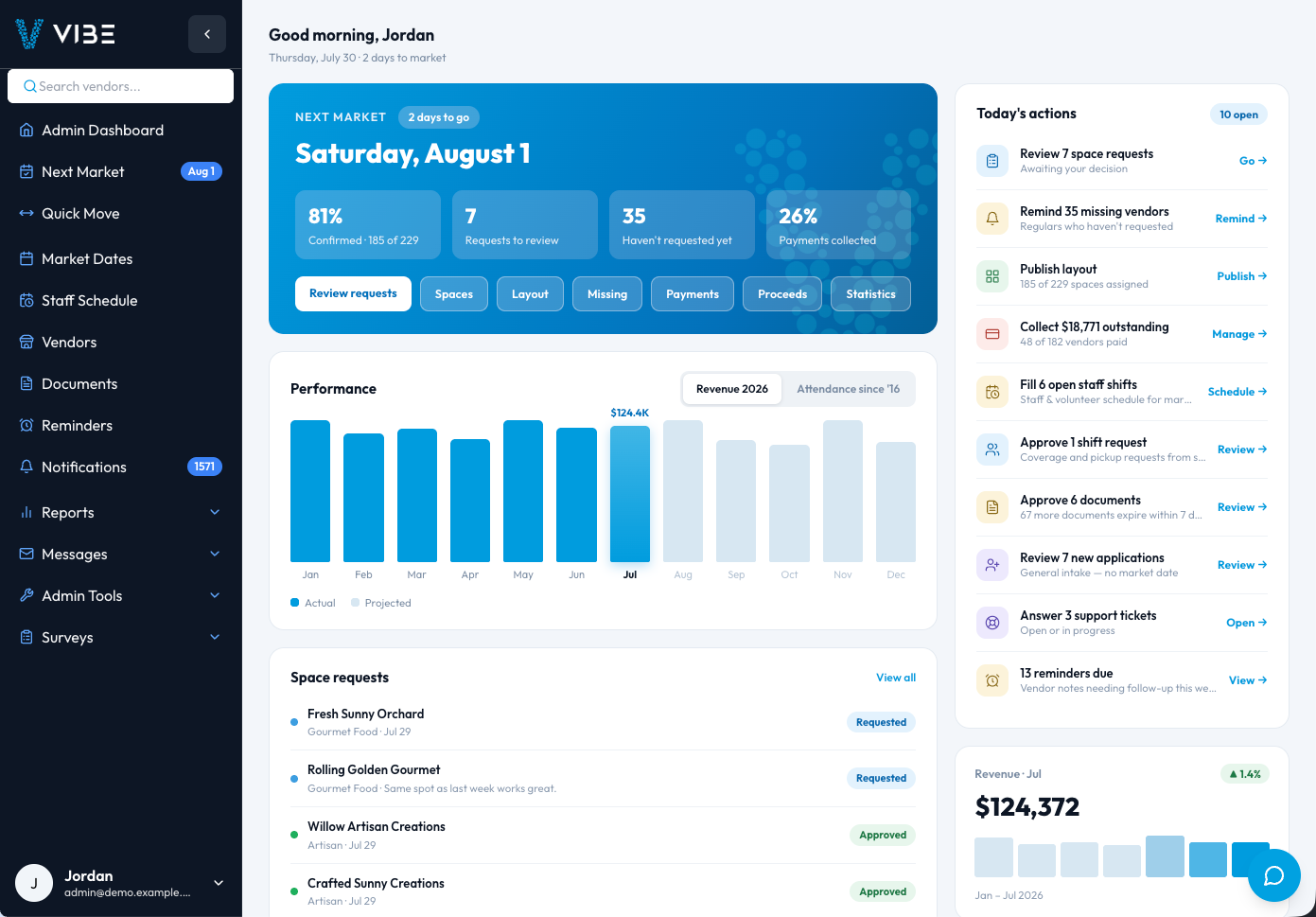
What replaces it: a vendor self-serve portal where vendors confirm their attendance for upcoming market dates themselves. You look at the list, not your phone.
2. Saturday 5:30am, shuffling paper to figure out the booth layout
You have a map. The map is a PDF. The PDF was accurate three weeks ago. Since then, two vendors canceled, one asked to move closer to the coffee cart, a new applicant got approved, and the farmer in booth 14 wants double space because her tomato haul was better than expected. You're sitting at the dining room table at 5:30am rewriting the map on a printed copy with a red pen.
What replaces it: a live drag-and-drop booth map that updates when a vendor confirms or cancels, so the layout you walk into on Saturday matches what's actually happening at 6am.
3. Monday morning, chasing down who paid and who didn't
Some vendors paid in cash. Some Venmo'd the wrong amount. Some Venmo'd you personally instead of the market account. Some wrote checks that are still in your glovebox. You open three apps and a bank account to reconstruct Saturday's payments, and by the time you're done you've written five reminder texts to people who owe you money.
What replaces it: online booth fees that invoice automatically, track payment status, and move money straight from vendors into your market's own bank account through your own merchant account. You look at one list, not four.
4. The insurance cert you didn't know had lapsed
Every prepared food vendor needs a certificate of insurance with you named as additional insured. Every farmer with hand-processed goods needs a cottage food permit. Every artisan with a soldering iron needs a fire marshal sign-off. These documents expire. The spreadsheet has a column for them but nobody looks at the column until the day a vendor's COI lapses and you find out because their insurance company calls you.
What replaces it: document tracking with expiration awareness that nags vendors for you, before the certificate goes stale, not after.
5. The weather change you had to announce in fourteen different places
Wind advisory for Saturday. You post in the vendor Facebook group. You send a group text. You email the ones who don't text. You message three people individually because they asked to be reached that way. Half the vendors see it, half don't, and you spend Saturday morning answering the same question over and over.
What replaces it: one message that goes to every vendor attending this Saturday through whatever channel they prefer, with delivery confirmation so you know who saw it.
6. The weekend you couldn't take off because everything was in your head
This is the real cost. A spreadsheet-based market is a market that depends on one person's memory, and that person can never take a weekend off. The assistant manager can't cover for you because the assistant manager doesn't know which tab has this week's confirmations or what the rule is for vendors who pay late or where the backup of the backup of the insurance folder is.
What replaces it: a system where everyone who helps run your market sees the same live truth, so the market can run without you in the room, and you can actually take a Saturday off.
What 'real market software' actually looks like
VIBEPro was built by walking a weekly market with the people who run it. Every feature above exists because a real manager needed it to work on a real Saturday morning. Not a single thing was designed in a conference room.
If any of the six moments above sounded painfully specific, if you recognized your own Friday night, your own 5:30am, your own Monday reconciliation, the problem isn't that you need a better spreadsheet. The problem is that you're using the wrong shape of tool for the job, and every week you wait is another Saturday you're tired when you shouldn't have to be.
More from VIBEPro
Get started
Ready to make your market run smoother?
Tell us about your market, how many vendors, how often you run, what's working and what isn't. We'll show you how VIBEPro fits. No pressure, no hard sell.
Talk to us about your market →