

Blog
Which farmers market software fits which kind of market
May 12, 2026 · Keith Mangold · 9 min read

We wrote about the eight questions to ask when you're evaluating any farmers market software tool. That post is a feature scorecard you can apply to anyone. This post answers the question that comes before the scorecard: of the tools that actually exist in this category today, which one fits the shape of your specific market?
Most wrong software choices in this category come from buying a tool built for a different shape of market than the one you're running. The scorecard catches the tool that's broadly weak. The shape question catches the tool that's strong but pointed at a different customer than you.
Step 1: Decide what kind of market you're actually running
There are roughly five shapes in this category. The first thing to do is figure out which one is yours.
Shape 1 — The new weekly market
Under 25 vendors. Maybe just launching. Volunteer-run or single-manager-run. Limited budget. Mostly farmers, maybe a few makers and food vendors. Sells out the season schedule once and reuses it.
Shape 2 — The established weekly market
25 to 100 vendors. Recurring weekly schedule. Real budget for software. Mixed vendor types: produce, prepared food, artisans, makers. Probably a paid manager. May charge a percentage of vendor sales, may charge flat booth fees, often both. This is where the largest part of the category lives.
Shape 3 — The big-tent multi-day festival or craft fair
Happens 1 to 3 times per year. 50 to 300 vendors. Different sales motion entirely — short setup, intensive day-of, then quiet for months. The buyer here doesn't need recurring weekly tooling; they need a vendor management system that works once and works hard.
Shape 4 — The multi-market organization
Same nonprofit or association running 2+ different markets in different locations or different days. Needs unified reporting across markets, shared vendor directory, and centralized billing. Real complexity even if individual markets are small.
Shape 5 — The membership association that occasionally does a market
Primarily a generic association with members and dues; the market is a side activity. The center of gravity is membership management, not market operations.
Be honest about which one you are. Most managers we talk to think they're shape 3 or 4 because it sounds bigger, when they're really shape 2. Shape 2 is where most of the category lives, and shape 2 is what most software is actually built for.
Step 2: Match the shape to the right tool
Here's how the shapes line up with the actual tools in the category today:
- Shape 1 (new weekly): VIBEPro Grow tier, or stay on spreadsheets one more season.
- Shape 2 (established weekly): the real fight. VIBEPro, Manage My Market, MarketSpread, or MarketWurks.
- Shape 3 (festival or craft fair): Eventeny, or VIBEPro's Festival per-event tier.
- Shape 4 (multi-market organization): MarketWurks for multi-location strength, or VIBEPro Orchard.
- Shape 5 (association with a market): Wild Apricot, or whatever membership tool you already use.
A quick honest tour of the actual tools
Each tool has a center of gravity. Here's where each one is genuinely strong, in our reading of the category as of 2026.
Manage My Market
The oldest tool in the category. Operating since 2003 out of Portland, OR. Used by markets in all 50 states plus Canada, UK, and Australia. Pricing is per-approved-vendor-application (~$15 each), which feels OK at small scale and gets painful as you grow. UX is dated — the .aspx URLs and 2017-era PDF "application instructions" tell you a lot — but the depth of feature coverage is real. Best fit if you're shape 2 and you specifically value international reach or a long track record over modern interface.
MarketSpread / Farmspread
The broadest of any direct competitor. Markets the same product to farmers markets, flea markets, antique markets, art markets, street fairs, county fairs, craft fairs, food festivals, trade shows, and ag shows. Recognized by the Farmers Market Coalition. Pricing is opaque ("contact us"), which we don't love. Best fit if you run multiple kinds of markets across the year and want one tool for all of them. Worst fit if you want a focused weekly-market product.
MarketWurks
Solid established player. $1,500/year minimum, supports 35–40+ vendors with no hard cap. Multi-location pricing for organizations running several markets. Has the strongest renewal flow in the category — pre-filled applications for returning vendors. Best fit if you're shape 4 (multi-market) or an established shape 2 with a real budget and a strong preference for nonprofit-association polish over startup velocity.
Eventeny
Not a farmers-market-native tool, but the strongest player on craft fairs, festivals, and one-off events. Modern branding. Charges a transaction fee (~3.5%). Aggressive marketing. If you're shape 3, they're winning that segment right now and they have the best festival-specific story in the broader market. If you're shape 2, they're a less natural fit because the recurring weekly model isn't where they live.
Wild Apricot
A generic membership management tool used by 15,000+ organizations including a handful of farmers market associations. Not market-aware. No booth maps. No weekly attendance flow. Document tracking via custom fields only. Best fit if you're shape 5 — primarily an association where the market is a side activity. Worst fit if your weekly market operations are the actual job.
Local Line
Modern, well-designed, but pointed at a different customer entirely: farms selling direct online, food hubs aggregating multiple farms, and vendor-side commerce. Not a market-management tool. If you're a market manager evaluating Local Line, it's probably the wrong tool. If you're a vendor at a market, it might be exactly right for your storefront — but that's a different problem from what we solve.
VIBEPro
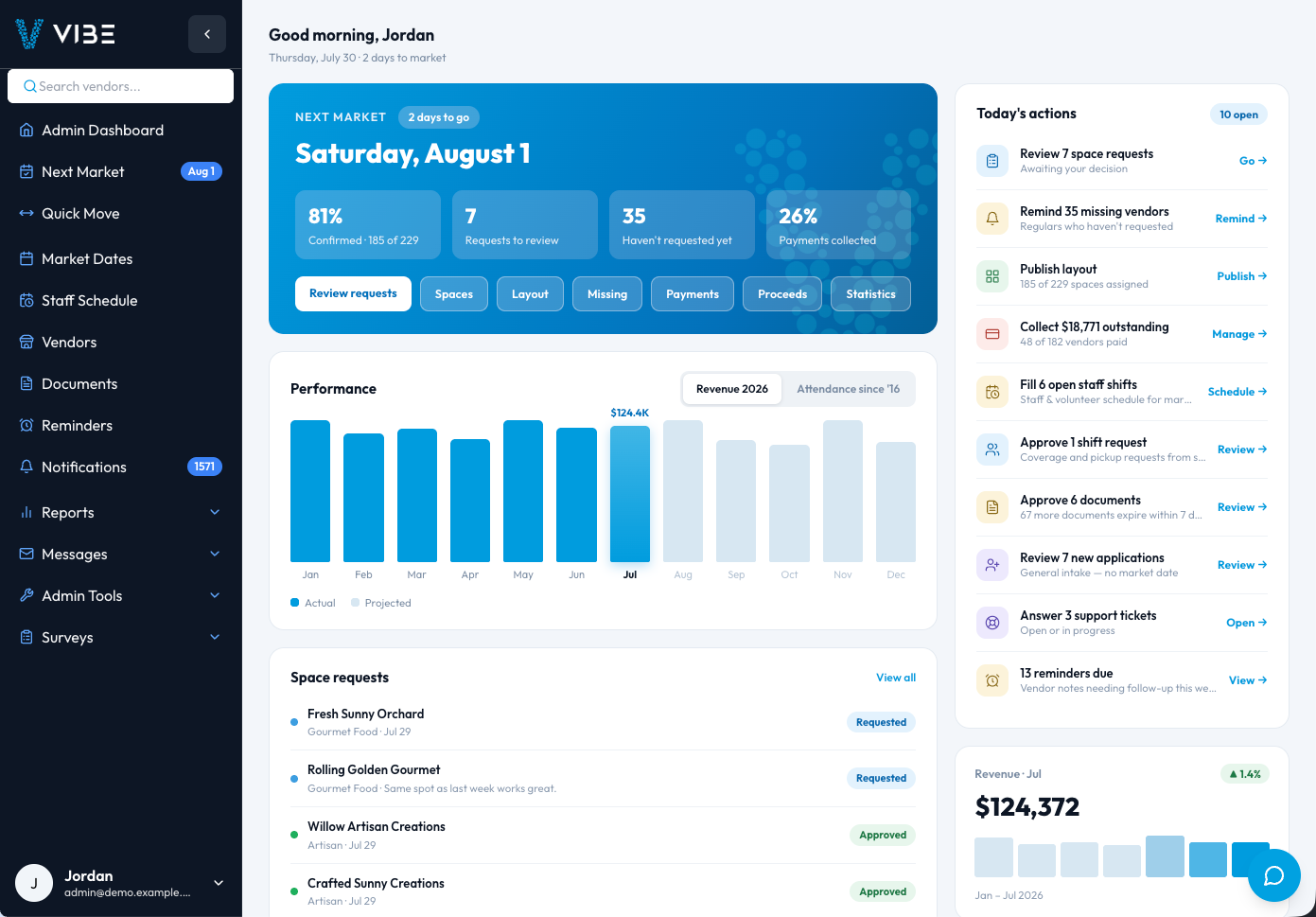
Us. Public tiered pricing (Grow, Run, Scale) for shape 1 and shape 2 markets, a per-event Festival tier for shape 3, and an Orchard custom contract for shape 4. Modern interface. Document tracking with expiration alerts as a first-class feature. Drag-and-drop booth map that's a real operations tool, not a marketing graphic. Flexible fee rules — flat booth fees, sales-based percentages, or both in the same workflow. Direct founder support. One-customer track record we're honest about.
Step 3: When VIBEPro is the right answer — and when it isn't
We'll say it straight. You should pick VIBEPro if you're shape 1 or shape 2 and any of the following are true:
- You want a modern interface (not 2003-era).
- You want public, predictable monthly pricing.
- You want flexible fee rules — flat, sales-based, or any mix — instead of being locked into one billing model.
- You want direct access to the founder for support.
- You like real production data over marketing testimonials.
You should pick someone else if:
- You're shape 5 (membership association with a market on the side) — Wild Apricot fits.
- You're shape 3 and the festival is the entire business — Eventeny is sharper for that.
- You need international currency or 6-country operation today — MarketWurks.
- You strongly prefer a 20-year-old vendor — Manage My Market.
- The most important thing to you is a logo wall of customers — wait 18 months and reconsider us.
The mistake to avoid
The single biggest mistake we see market managers make is picking a tool because it has the most features. Features are not the same as fit. A tool with 50 features that match your market beats a tool with 200 features that almost match.
The second biggest mistake is waiting too long to pick anything at all. The cost of running a market on spreadsheets for one more season is real, even if it doesn't show up on a P&L. It shows up as your weekends.
More from VIBEPro
Get started
Ready to make your market run smoother?
Tell us about your market, how many vendors, how often you run, what's working and what isn't. We'll show you how VIBEPro fits. No pressure, no hard sell.
Talk to us about your market →